







Why Outsourcing Web Development Is a Startup Game-Changer
Here’s why startups outsource web development. Early-stage tech companies tend to live or die on how fast they ship, who builds the product and what it costs. Hiring a full in-house engineering team is slow and expensive, which is why outsourcing website development has become a growth lever rather than a simple cost-cutting move. Deloitte’s 2024 Global Outsourcing Survey tracks why organisations outsource, including cost and access to specialist skills.
A trusted web development service provider gives founders experienced remote web developers and dedicated developer teams without the delays of traditional hiring. Whether the setup is onshore, nearshore or offshore, the right partner brings the technical expertise you need and leaves your core team free to scale the business.
| Model | Where the team sits | Time zone overlap | Best for |
|---|---|---|---|
| Onshore | Same country | Full | Work that needs in-person contact or strict local compliance |
| Nearshore | Neighbouring region (for US teams, LATAM) | Mostly shared working hours | Daily collaboration and real-time handoffs |
| Offshore | Distant region (for example, the Philippines) | Limited, often a follow-the-sun cycle | The biggest savings and round-the-clock progress |
Faster Launches and Shorter Development Cycles
Every week of delay is a week a competitor can use. Recruiting engineers locally can take months, while a dedicated outsourced team can usually start work within days, so output scales when the product needs it to.
Salmon Software cut its time-to-hire by 80% after Cloud Employee built a customised front-end web developer team for it in the Philippines. The faster hiring turned into an earlier product launch and a real competitive edge.
Access to Hard-to-Find Skills
Outsourcing website development removes the limit of whoever lives within commuting distance. Global providers can supply engineers with deep experience in niche frameworks, emerging tools and complex tech stacks that a local search might never turn up. The U.S. Bureau of Labor Statistics projects faster than average growth in software developer jobs, so competition for local engineers is not easing.
Event Connections needed full-stack .NET engineers who could turn a legacy system into a scalable platform. Cloud Employee’s dedicated developers gave them the exact skill mix without a long recruitment cycle or any compromise on the brief.
Optimised Costs Without Cutting Corners
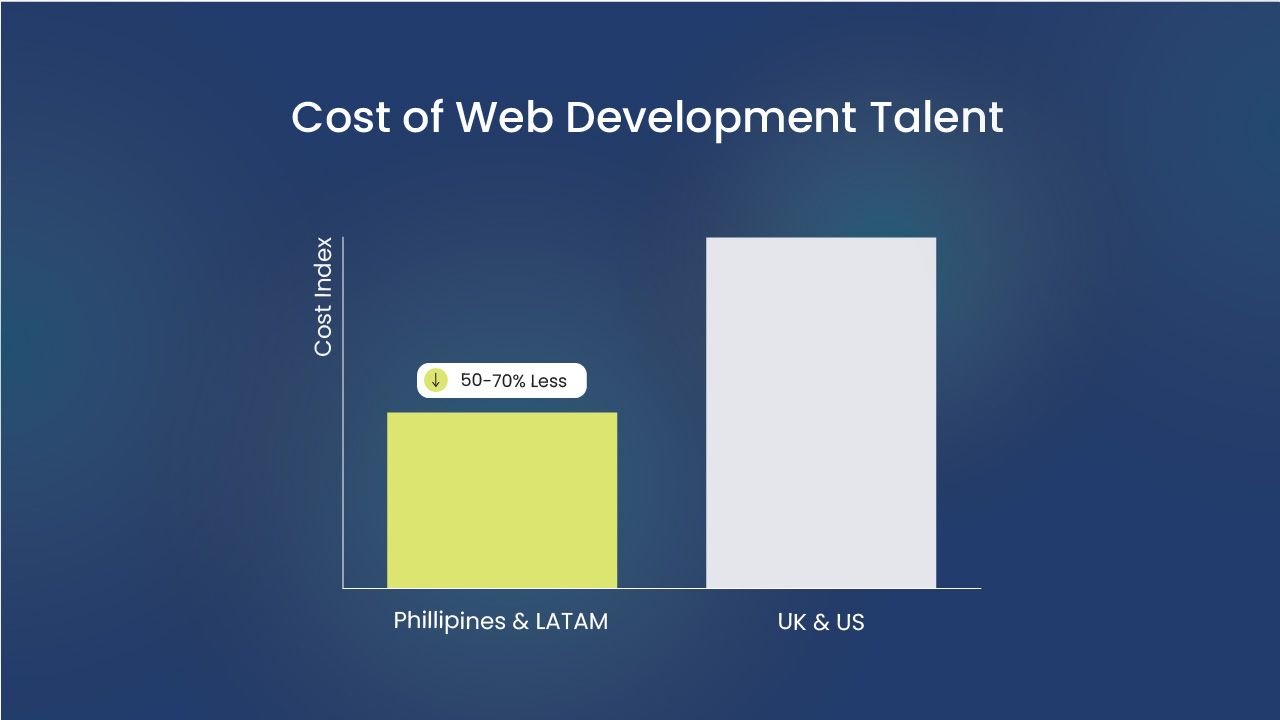
In-house developer salaries in the UK, US and Australia can price early-stage startups out of the market. Outsourcing to the Philippines or Latin America (LATAM) offers engineers at 50 to 70% lower rates and a far better cost-to-quality ratio.
Savings only count if the code holds up. Pick a provider with proven quality controls, a structured onboarding process and transparent communication, so lower rates never cost you code quality or delivery dates.
Built-In Scalability
Startup workloads rarely run flat. Launches bring intense bursts, and quieter optimisation phases follow. Outsourcing lets you scale a dedicated developer team up or down quickly, without carrying the cost of permanent hires.
Under Cloud Employee’s flexible model, clients add or remove offshore engineers within weeks, so capacity follows the roadmap.
Founders Stay Focused on Strategy
Founders and core engineers who are not buried in bug fixes and feature tickets can spend that time winning customers, refining the business model and raising investment.
The most successful startups know that outsourcing web development isn't only about cost efficiency, it's about getting access to the right skills fast and buying time. By extending their capacity with top-class team, they keep their core team motivated and focused on strategic planning, while delivery is placed in the right hands.
Anto Čabraja
CTO at Cloud Employee
Reduced Delivery Risk
Reputable web development outsourcing companies arrive with project management frameworks, QA processes and communication tools already in place, which lowers delivery risk. You are not hiring one developer. You are plugging into the operational backbone of a professional outsourcing partner.
Cloud Employee runs a staff augmentation model in which CTO-vetted developers join your team and shape their output around your processes, keeping projects on track and to the agreed standard.
Development That Never Sleeps
Offshore teams turn time zone gaps into extra working hours. A UK or US startup with remote web developers in the Philippines or LATAM wakes up to completed work, because progress continues while the local team sleeps.
Commonly Outsourced Web Development Services for Startups
Startups often choose to outsource:
- Front-end development (React developers, Angular and Vue.js specialists)
- Back-end development (Node.js developers, Laravel and Django specialists)
- Full-stack engineering (TypeScript developers working across front end and back end)
- E-commerce and CMS builds (Shopify, WordPress)
- Custom web application development
- Quality assurance and testing
Pros and Cons of Outsourcing Website Development
Website development outsourcing pays off for most startups, but it is not free of trade-offs. Weigh both sides before you sign.
Pros
- Developers start working within days instead of months
- Access to niche skills you cannot hire locally
- Lower rates, with savings of 50 to 70% in the Philippines and LATAM
- Team size that flexes with your roadmap
Cons
- Less day-to-day control than an in-house team
- Time zone gaps can slow real-time communication
- Quality varies from one provider to another
- Knowledge transfer, security and IP terms need clear contracts
Where Outsourcing Can Go Wrong, and How to Avoid It
Outsourcing website development projects usually fail for three reasons: communication breaks down, expectations stay vague, or the provider is chosen on the lowest bid. These habits prevent most of it:
- Write down deliverables, scope and acceptance criteria before work starts.
- Run regular check-ins and sprint reviews so problems surface early.
- Vet the provider thoroughly and ask for verified case studies and client testimonials.
- Agree on time zone overlap, tools and reporting up front.
The Strategic Advantage Is Clear
Choosing to outsource web development instead of hiring locally is about more than saving money. It buys the agility, expertise and scale a startup needs to compete, and the right partner becomes an extension of your team that delivers quality code, predictable timelines and measurable results.
Cloud Employee has helped startups worldwide build and scale dedicated offshore developer teams that deliver on time and to spec. Browse our customer stories to see how partners have grown faster through smart outsourcing.
If you are ready to scale faster, Cloud Employee connects you with vetted remote developers in the Philippines and LATAM. Let’s build your next big release together.
FAQs
What is the best country to outsource web development?
There is no single best country. The Philippines and Latin American countries both offer skilled engineers, strong English proficiency and cost-effective rates. The better fit depends on how much time zone overlap your team needs.
How much does it cost to outsource web development?
Costs vary by skill, seniority and region. Outsourcing to the Philippines, for example, can save 50 to 70% compared with hiring locally in Western markets. Pricing models matter too, so compare hourly rate vs monthly fee before you commit.
What’s the difference between offshore and nearshore outsourcing?
Offshore outsourcing places teams in distant time zones, which can save the most money and keep work moving overnight. Nearshore uses teams in neighbouring regions, so working hours overlap and collaboration is easier. Our guide to nearshore vs offshore staff augmentation breaks down the trade-offs.
Can I hire a remote front-end developer for a short-term project?
Yes. Many web development outsourcing companies offer flexible short-term contracts tailored to project needs. Define the scope, deliverables and end date upfront so the engagement stays focused.
Is outsourcing website development a good idea for a startup?
It often is, when speed and budget are tight. Outsourcing website development lets a startup launch sooner, reach skills it cannot hire locally and scale the team as workloads change. It works best with clear deliverables and a vetted provider, because the biggest risks are communication gaps and quality that varies between vendors.
What are the disadvantages of outsourcing web development?
The main drawbacks are less day-to-day control, time zone gaps and quality that varies from one provider to another. Knowledge transfer and security also need clear contracts. Detailed deliverables, regular sprint reviews and a thoroughly vetted provider reduce most of these risks.
How do I choose a website development outsourcing company?
Look for verified case studies, client testimonials and proven quality controls. Check how a website development outsourcing company handles onboarding, communication and QA, and confirm the team has the exact stack you need, such as React or Node.js. Avoid choosing on the lowest bid alone.