





Those figures come from 112 counted Cloud Employee placements across the region from January 2023 through September 2026. Since each monthly fee already covers salary, payroll taxes, benefits and equipment, the saving against a comparable US or UK hire typically runs 50 to 75 percent. This guide breaks the 2026 numbers down by seniority, country and role.
The bands come from 112 counted placements from January 2023 through September 2026, sample: 112 placements, January 2023-September 2026, client bill rates, 10th-90th percentile method, USD, current as of September 2026. Not measured: performance variation by client industry. Each all-in fee covers salary, payroll taxes, benefits, equipment and a dedicated Client Success Manager, saving clients 50 to 75 percent against a comparable US or UK hire.
How much do Latin American developers cost per month?

Latin America developer costs through Cloud Employee save 50-75% vs US hires, with junior engineers at $3,000-$4,500/month, mid-level at $4,500-$6,500/month, and senior at $6,500-$15,000/month. Seniority moves the fee more than country does.
Table: Cloud Employee LATAM fee bands by seniority
| Level | Monthly fee USD | Annualized midpoint | Hourly equivalent |
|---|---|---|---|
| Junior | $3,000-$4,500 | $45,000 | $19-$28 |
| Mid | $4,500-$6,500 | $66,000 | $28-$41 |
| Senior | $6,500-$15,000 | $93,000 | $41-$94 |
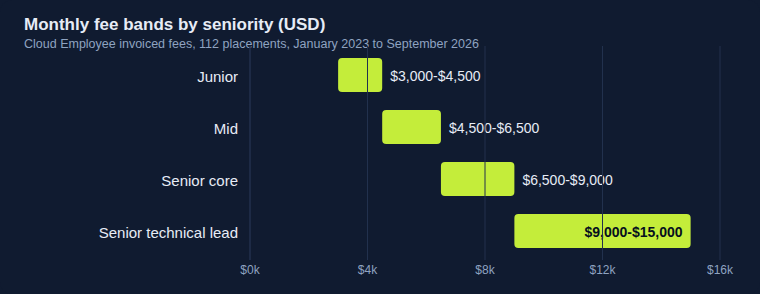
Chart: Cloud Employee invoiced fee bands, 112 placements, January 2023 to September 2026.
Methodology. Sample: 112 Cloud Employee LATAM placements, January 2023 through September 2026. Bands come from actual client bill rates, with self-reported salary data excluded, and the 10th-90th percentile of the sample sets each seniority band. Figures are USD, current as of September 23, 2026.
Hourly equivalents divide monthly fees by 160. Not measured: performance variation by client industry, project-based pricing, and rates outside Cloud Employee's own placement records.
The senior hourly equivalent range spans $41-$56 for core senior roles up to $94 for lead and principal tiers; the methodology box above carries the sample and method.
The annualized midpoints are the planning numbers: $45,000 a year for a junior, $66,000 for mid and $93,000 for core senior ($129,000 across the full $6,500-$15,000 band). Each fee is set per engineer and adjusted case by case, so treat the bands as ranges rather than flat list prices.
Levels are defined by capability rather than years of service. A junior builds for themselves or is still learning domain context, a mid-level engineer owns features end to end, and a senior brings systems thinking, autonomous execution and the ability to manage AI outputs. Cloud Employee predominantly supplies engineers at senior and above, 92 percent of 2026 placements, with junior and mid-level sourced case by case.
Teams that need to hire senior engineers in Latin America can see the level-by-level supply on the LATAM developers service page.
The bands are built on the 112-placement sample described in the methodology box above. That sample is what separates these numbers from the field. They are invoiced rates from Cloud Employee placement records, so the figure you budget against is the figure a client actually pays.
If you are comparing vendors, ask for the sample behind any band you are quoted; a range with no counted placements behind it is a marketing number, not a budget number. The founder checklist on how to evaluate staff augmentation providers in LATAM turns that advice into a worked list.
Each monthly fee is fully loaded: engineer salary, employer payroll taxes, private healthcare and statutory benefits, equipment, software licenses, a dedicated Client Success Manager, HR administration, a $1,400 annual learning budget per engineer, and free replacement if the fit is wrong. There are no upfront, recruitment or placement fees on the embedded model, and no minimum contract.
When a competitor quotes less, check whether the figure is base salary alone; the loaded comparison is the only one that holds for budgeting. To calculate your own all-in monthly cost, the pricing page carries the current calculator against these bands.
"I just love Brazil. Latin America was a good sweet spot for us. We were able to hire two senior engineers and a QA engineer, three hires, all under budget, with no permanent headcount commitment. It was probably the best Scrum team I've ever had."
Denise Marie Deptula, CTO, Frontline Group, September 2026
"Our vetting process scores engineers on six dimensions - systems thinking, AI tooling proficiency, agent orchestration, leadership, compliance and precision, and psychometric profile. Lets say an engineer who scores 9/10 on systems thinking and has proven Kubernetes production experience will be at $8,500/month. One who has that but also commands agentic swarms in the correct way and can operate at a lead level could hit $10,000-$12,000. The premiums aren't arbitrary. They're verified through live exercises during our seven-stage process. Stack scarcity matters less now. What moves the needle is whether an engineer can think in systems, orchestrate AI agents, and operate with the precision that compliance-heavy industries demand."
Anto Cabraja, Founding CTO, Cloud Employee
Does Colombia cost more or less than other LATAM countries?
Hiring a developer in Colombia through Cloud Employee costs the same as hiring the same level anywhere else in the region. A junior engineer runs $3,000-$4,500 a month, $4,500-$6,500 for mid-level, and $6,500-$9,000 for senior, rising to $15,000 for lead engineers and principal architects. Cloud Employee sets the fee per engineer, with country playing no part in the number, and the monthly fee is fully loaded.
It covers engineer salary, employer payroll taxes, private healthcare, equipment, software licenses and a dedicated Client Success Manager. For a founder comparing hubs, that means the quote for a Bogota engineer prices seniority alone; Colombia itself adds neither discount nor premium.
Colombia is also the best-sampled country behind those numbers. The table below counts every Latin America placement from January 2023 through September 2026: 112 engineers, of which 45 sit in Colombia, a 40 percent share. The bands are built on these actual client bill rates from Cloud Employee's invoicing records rather than third-party salary aggregates.
When a competitor quotes you a Colombia rate with no sample behind it, this is the count Cloud Employee can put against it.
Counted LATAM placements by country, January 2023 through September 2026
| Country | Placements | Share |
|---|---|---|
| Colombia | 45 | 40 percent |
| Argentina | 28 | 25 percent |
| Mexico | 23 | 20 percent |
| Brazil-Uruguay | 16 | 15 percent |
| Total | 112 | 100 percent |
Where country does move the fee, it moves it less than seniority does. The fee for the same level varies by country by less than the gap between levels, adjusted case by case with the client. Choose Colombia for timezone overlap and stack fit; the price edge is minimal. Bogota is one of Cloud Employee's named Latin America hubs, so Colombia placements come with local delivery capacity.
What hourly rate do the monthly fees equal?
Cloud Employee bills a fixed monthly fee per engineer; hourly rates never enter the bill. The fee is quoted in the client's currency and does not change month to month, so a founder budgeting headcount plans against one number instead of a variable invoice.
If you budget in hours, convert the bands: the Latin America fee bands work out to an hourly equivalent of $19 to $56 at 160 hours a month, current as of September 23, 2026. By level, that is junior $19 to $28, mid $28 to $41 and senior $41 to $56. The divisor matters.
Stating the 160-hour divisor keeps the comparison honest. The word equivalent matters too. A bare hourly rate reads as a freelance offer, when this is a full-time employed engineer.
The deeper treatment of hourly rate vs monthly fee pricing models, with worked team-size examples, sits in the dedicated guide.
The fee is fully loaded: engineer salary, employer payroll taxes, private healthcare, equipment, software licenses, a dedicated Client Success Manager and HR administration. A job board hourly rate covers salary alone, so it looks cheaper than a like-for-like employed hire.
Loading applies on the US side as well. Cloud Employee's benchmark model adds 40.0 percent employer on-costs to base salary, which puts a fully loaded senior full-stack hire at $210,975 a year. Compare loaded cost against loaded cost, or the saving gets understated.
The same logic applies on the buy side: the hidden fees and placement costs in LATAM hiring, from placement fees to contract minimums, are itemised in the LATAM pricing models guide.
Which is cheaper: Argentina or Mexico?
Cloud Employee's biggest Latin America hub is Mexico City, with 30 to 40 engineers; Buenos Aires and Bogota are the other named hubs. For a founder comparing the two, hub size is a proxy for local delivery capacity.
Mexico City holds the largest concentration of Cloud Employee engineers, while Argentina carries the deeper placement record. Of 112 counted LATAM placements from January 2023 through September 2026, 28 went to Argentina and 23 to Mexico, a 25 percent to 20 percent split. Either market is a safe choice: both carry dozens of counted placements behind them, so pick on timezone and stack fit rather than fear of an untested market.
On price, the comparison is simple because Cloud Employee sets fees per engineer, so the fee for the same level varies by country by less than the gap between seniority levels. The country-level numbers behind that comparison, market by market, sit in the guide to software development costs by country.
How much cheaper are LATAM senior developers vs US?
US companies find affordable senior engineers in Latin America, and the number to compare is fully loaded cost; base salary alone understates it. Employer taxes, health insurance, a 401(k) match, a 20 percent recruiting fee and equipment push a senior US full-stack hire to $210,975 in year one.
The 2026 nearshore vs offshore rate benchmarks for the other sourcing regions are tabulated in the regional guide.
Cloud Employee's counted LATAM placements bill the same role at $96,000 a year as of September 23, 2026, a 54 percent saving of $114,975. Cloud Employee sources those engineers from Colombia, Argentina, Mexico and Brazil-Uruguay, the four countries behind its 112 counted LATAM placements from January 2023 through September 2026.
Senior role savings vs US fully loaded cost, September 2026
| Role | Cloud Employee LATAM annual | US fully loaded annual | Saving |
|---|---|---|---|
| Full-Stack Developer | $96,000 | $210,975 | 54% ($114,975) |
| DevOps Engineer | $101,050 | $235,000 | 57% |
| AI/ML Engineer | $105,600 | $240,000 | 56% ($134,400) |
| QA Engineer (automation) | $62,900 | $185,000 | 66% |
Savings run from 54 to 66 percent, and the deepest percentage sits on QA automation, where a $185,000 US fully loaded cost meets a $62,900 LATAM fee. When you compare quotes, check the definition behind each column. These US figures are fully loaded costs sourced September 2026 from BLS ECEC, Glassdoor and industry benchmarks, all fully loaded.
The public wage tables behind the two government-sourced rows are BLS OEWS wage data for software developers (SOC 15-1252) and BLS wage data for software QA analysts and testers (SOC 15-1253).
Price is half the ratio; retention is the other half. Of 80 LATAM engineers placed between January 2023 and September 2024 (sample: 80, client retention records), 78 remained with their original client at the 24-month mark, a 97.5 percent retention rate. Not measured: variation by client industry. That figure carries its denominator, 80 counted engineers, so you can weigh it against any competitor's satisfaction claim that names no cohort.
The mechanism behind that retention, our 90-day ramp-up playbook for LATAM developers, is documented separately.
"Our 97.5% retention at 24 months isn't accidental. We track every engineer in a cohort from day one. Out of 80 LATAM engineers placed through September 2024, 78 are still with their original clients. That's the number. Behind it is a structured 90-day onboarding, a dedicated Client Success Manager who responds within 24 hours of any concern, and $1,400 per engineer per year in L&D. But honestly, the biggest driver is the psychometric matching. We don't just place an engineer anywhere. We match their work style and growth trajectory to the right environment. That's why they stay."
Rich Holgate, COO, Cloud Employee
What hidden costs does Cloud Employee remove?
The cheapest way to hire senior developers is the route with the lowest cost of being wrong. Sticker rates mislead. A freelance hourly rate or a salary-survey figure looks cheaper until the hire fails and you fund the search a second time. We quantify the true cost of an hourly marketplace like Arc.dev in a dedicated comparison, fee by fee.
Cloud Employee's core senior band is $6,500 to $9,000 a month, and the terms around that fee are what keep the total cost down. There is no minimum contract. The engagement is one-month rolling and can be ended with 30 days notice. For a founder comparing costs, that means a senior engineer can be tested for a single month without a sunk commitment.
There are no upfront fees, no recruitment fee, no placement fee and no percentage of salary on the embedded model; the client starts paying when the engineer starts. A US company hiring the same senior role locally pays a recruiter 20 percent of first-year salary, paid on the start date. That fee is sunk before anyone knows whether the hire works out.
The in-house vs staff augmentation total cost of ownership arithmetic, run over two years side by side, is set out on the TCO page.
The guarantee has two halves: a two-week money-back period and free developer replacement if the engineer is not the right fit. Two vetted candidate profiles arrive within seven working days, measured on Q3 2026 active searches. A wrong pick costs two weeks instead of a fresh recruiting cycle.
Retention closes the case. Of 80 LATAM engineers placed between January 2023 and September 2024, 78 were still with their original client at the 24-month mark, 97.5 percent. A low rate that ends in churn is the expensive route; this cohort shows the cheap fee holding. The common objections to that arithmetic are answered one by one in LATAM staff augmentation myths debunked.
"We publish fixed monthly fees because it's what clients actually pay. No hidden costs, no surprise invoices. A senior engineer is $6,500-$15,000 depending on a few things… Such as ability with agent orchestration, compliance expertise, leadership level. And that of course includes salary, benefits, equipment, a dedicated CSM, everything. Compare that to hourly rates where you're still managing compliance, benefits, and replacement risk yourself. Or lets say to a US hire at $240,000, and fully loaded, that can reach $350,000. No minimum commitment, one-month rolling, cancel anytime. Theres no need to lock you in because we don't need to. The retention speaks for itself."
Seb Hall, CEO, Cloud Employee
The quote's $240,000-$350,000 range is the CEO's read across the broader market: different seniority mixes, sourcing channels and year-one totals. The $210,975 this article benchmarks is the narrow case - one senior full-stack engineer's base plus 40.0 percent employer on-costs, September 2026 - so hold quotes against the table above rather than against either number in isolation.
How does Cloud Employee vet Latin American developers?
Cloud Employee maintains a pre-screened network of more than 11,000 engineers across Latin America, built over six years of sourcing in Colombia, Argentina, Mexico, Brazil and Uruguay. Engineers enter that network primarily through referrals and inbound applications, and only after baseline screening: a skills self-assessment, an English proficiency check and work-authorization verification.
Senior engineers run the vetting end to end. Each candidate moves through a screening call, a Coderbyte technical assessment with integrity checks against copied or AI-written code, a live pair programming session with senior Cloud Employee engineers, a project walkthrough, a technical advisor review and a final interview, before CTO approval. Two matched profiles reach the client.
The funnel has counted numbers behind it. Of 1,247 developer applications received between September 2025 and February 2026, 35 percent lacked meaningful commercial experience in the role they applied for, and their pass rate through live technical vetting was 14 percent, against 41 percent for experienced applicants. Levels are defined by capability alone.
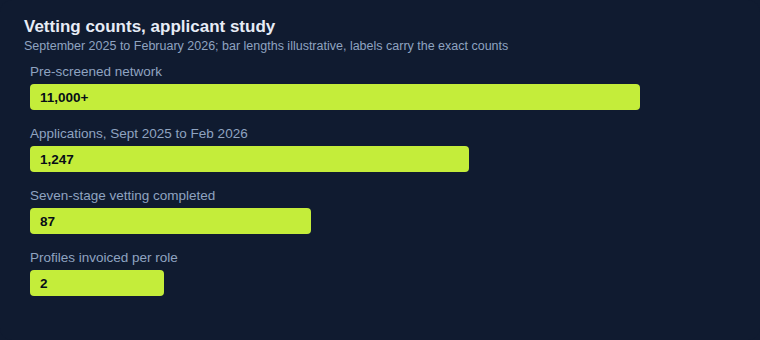
Chart: Vetting counts from Cloud Employee's applicant study, September 2025 to February 2026.
Mid-level owns features end to end; senior brings systems thinking, autonomous execution and the ability to manage AI outputs. Senior engineers made up 92 percent of 2026 placements.
The live pair programming session scores judgment and AI-tool direction rather than years of service.
A well-guided junior (14 percent of placements) with the right mindset can ship, which is why vetting tests understanding rather than code generation. The two profiles that reach you have already survived a filter that screens out most inexperienced applicants before you spend an hour on the call.
How does Cloud Employee's pricing model differ?
The three hiring models quote three different numbers, which is why published Latin America rates contradict each other. Freelance marketplaces quote an hourly contractor rate: Athyna lists senior LATAM developers at $55 an hour (a published marketplace rate, quoted from Athyna's own listings in September 2026). Employer of record platforms quote salary plus statutory costs, which Revelo wraps in a "True Cost Multiplier". Embedded staff augmentation bills one monthly fee per engineer with employment costs inside it.
Cloud Employee's embedded model bills one monthly fee per engineer covering salary, employer payroll taxes, private healthcare and statutory benefits, equipment, software licenses and tooling, a dedicated Client Success Manager, HR administration and compliance, and a $1,400 annual learning budget per engineer. There are no upfront, recruitment or placement fees, and the client starts paying when the engineer starts.
For budgeting, the invoice figure is the planning figure. Nothing lands later.
The comparison that matters is fully loaded against fully loaded. Cloud Employee's US benchmark model, built September 2026, adds 40.0 percent employer on-costs to base salary: Social Security, Medicare, unemployment insurance, health insurance, 401(k) match and a recruiting fee. That loading is why a $55 freelance rate and a $8,000 monthly senior full-stack fee can describe the same engineer. The freelance rate excludes the costs the monthly fee carries.
Two questions separate nearshore companies for a US founder: what does the quoted figure include, and what data sits behind it? Cloud Employee publishes its fee definition with every band and builds its bands on 112 counted placements from January 2023 through September 2026, actual client bill rates rather than survey scrapes.
The ranking of the best staff augmentation companies in Latin America applies both tests across the field.
Cloud Employee's embedded staff augmentation model bills one monthly fee per engineer covering salary, employer payroll taxes, benefits, equipment, software licenses and account management, with no upfront or placement fees. Freelance and salary-survey figures state base pay only; Cloud Employee's US benchmark model, built September 2026, adds 40.0 percent employer on-costs to reach fully loaded cost. Cloud Employee publishes its fee definition with every band.
How do LATAM rates compare to Eastern Europe and Philippines?
Hourly equivalent by sourcing region at 160 hours a month
| Region | Hourly equivalent |
|---|---|
| Latin America (junior to core senior) | $19-$56 |
| Eastern Europe | $28-$56 |
| Philippines | $25-$38 |
The overlap is the finding. All three regions share the $28-$38 middle, and Latin America and Eastern Europe share the $56 ceiling. Seniority moves the rate more than region does. Latin American juniors run $19-$28 an hour and seniors $41-$56, a wider spread than the gap between any two regional floors.
Each equivalent is a full-time monthly fee divided by 160, a derived planning figure rather than a freelancer's rate. The fee covers salary, payroll processing, employer taxes, benefits, equipment and workspace, a dedicated Client Success Manager and account management, with no upfront, recruitment or placement fees, so a buyer comparing it against a US fully loaded cost adds nothing on top.
The Latin America band is current as of September 23, 2026 and rests on 112 counted placements from January 2023 through September 2026. Those are invoiced bill rates taken straight from client invoices.
FAQ: what does it cost to hire a developer?
These are the cost questions this guide answers from Cloud Employee's counted placement data.
How much does it cost to hire a developer in Latin America?
A US client pays Cloud Employee $3,000-$4,500 a month for a junior engineer, $4,500-$6,500 for mid-level and $6,500-$15,000 for senior. The bands come from 112 counted placements between January 2023 and September 2026, so they reflect actual client bill rates throughout.
How much does it cost to hire a developer in Colombia?
Colombia is Cloud Employee's largest sourcing country, with 45 of 112 counted LATAM placements between January 2023 and September 2026, a 40 percent share. Fees are set per engineer, so the regional bands apply in Bogota unchanged: mid-level there costs $4,500-$6,500 a month.
Is it cheaper to hire developers in Mexico or Argentina?
Cloud Employee placed 28 engineers in Argentina and 23 in Mexico of 112 total between January 2023 and September 2026. Fees are set per engineer, so the seniority gap moves your fee more than the Mexico-Argentina choice does.
What does a senior developer cost per month?
The senior band runs $6,500-$15,000 a month. The core is $6,500-$9,000, and the upper band applies to lead engineers and principal architects. The annualized midpoint is $93,000, the number to hold against the $210,975 US fully loaded senior full-stack cost.
What hourly rate does the monthly fee work out to?
At 160 hours a month, Cloud Employee's Latin America fees equal $19-$56 an hour (junior through core senior). The hourly figure is derived from monthly fees divided by 160 hours, stated for comparison only. Sample: 112 placements, January 2023-September 2026, client bill rates, 10th-90th percentile method, USD, current as of September 2026.
How much do I save against a US hire?
Cloud Employee's September 2026 calculations show 54 percent saved on senior full-stack, $114,975 against a $210,975 US fully loaded cost, 57 percent on DevOps, 56 percent on AI/ML and 66 percent on QA. Each percentage pairs a counted LATAM bill rate with a sourced US benchmark, so both halves check out.
What does the monthly fee include?
One monthly fee covers salary, employer payroll taxes, private healthcare, equipment, software licenses, a dedicated Client Success Manager and HR administration. There are no upfront, recruitment or placement fees on the embedded model, and billing starts when the engineer starts, so the quoted number is the whole cost.
Is there a minimum contract or a guarantee?
There is no minimum contract. The engagement is one-month rolling and you can end it with 30 days notice. The guarantee has two halves, a two-week money-back period and free developer replacement. Two vetted candidate profiles arrive within seven working days of the requirements call, measured on Q3 2026 active searches.
Bottom line: 2026 Latin America developer hiring costs

Latin America developer costs through Cloud Employee save 50-75% vs US hires, with junior engineers at $3,000-$4,500/month, mid-level at $4,500-$6,500/month, and senior at $6,500-$15,000/month.
Those bands are counted from 112 Cloud Employee LATAM placements and were current as of September 23, 2026. Measured against US fully loaded costs of $210,975 for full-stack, $235,000 for DevOps, $240,000 for AI/ML and $185,000 for QA, the savings are 54 percent on a full-stack developer, 57 percent on DevOps, 56 percent on AI/ML and 66 percent on QA.
The monthly fee already covers salary, payroll, taxes, benefits and equipment, and no recruitment or placement fee sits on top, so the comparison is all in against all in.
Those two sets of numbers are the ones to hold any 2026 LATAM quote against.