







Table of contents
- Nearshore Staff Augmentation Models
- Who manages what in each nearshore development team model?
- What does a nearshore dedicated development team actually mean?
- When does project outsourcing make sense, and when does it get expensive?
- Benefits of Nearshore Staff Augmentation
- How the Nearshore Staff Augmentation Model Works
- What does staff augmentation require from your team?
- Nearshore vs Offshore Staff Augmentation
- When Nearshore Staff Augmentation Makes Sense
- Nearshore Staff Augmentation Costs and Risks
- What do nearshore engineers cost under each model?
- What are the exit terms, and what happens if an engineer leaves?
- Who owns the code and IP in a nearshore engagement?
- What should you confirm before signing?
- How do you choose the right model?
- Case Study: Mercato
- Case Study: Travel Tech Client
- In Summary:
- FAQs
Nearshore Staff Augmentation Models
Most nearshore staff augmentation models fall into three types. The right nearshore software staff augmentation setup depends on how much of your roadmap the new engineers will own.
| Model | How it works | Best for | Who manages the work |
|---|---|---|---|
| Single engineer | Add one specialist to your team | Filling one skill gap, such as a React or DevOps role | You |
| Dedicated team | Add a group of engineers who work only on your product | Scaling a product area or a new feature stream | You, with a team lead |
| Blended nearshore and offshore | Nearshore leads work in your hours while offshore engineers handle well-defined execution | Teams of 5 or more that want to balance collaboration and cost | You |
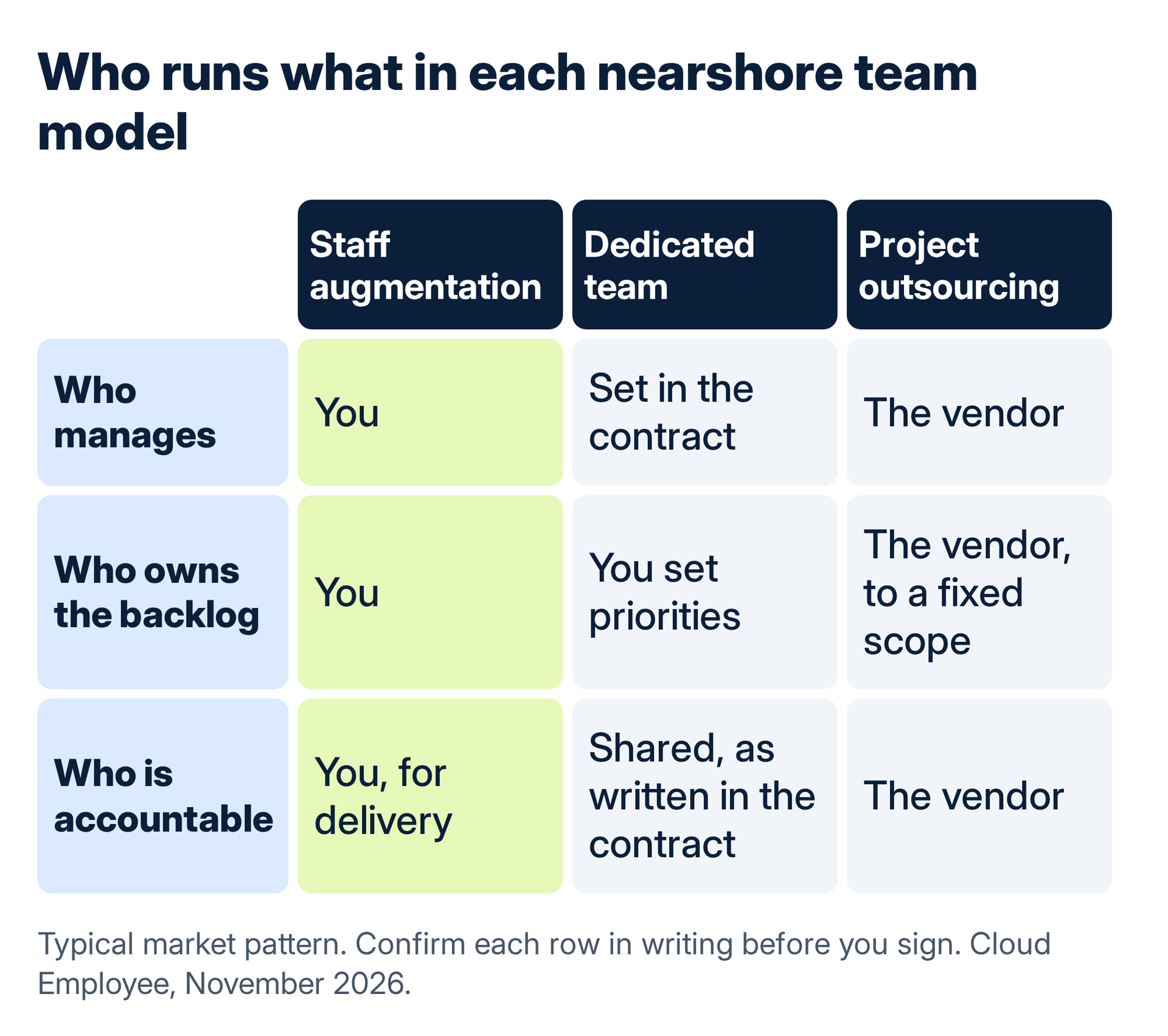
The three models side by side, on the questions that decide everything else in the contract.
Cloud Employee sells staff augmentation only. Its engineers join your team, work your timezone and report directly to you, and Cloud Employee handles hiring, employment and replacement. It does not run fixed-scope projects or take responsibility for delivery outcomes, so this guide covers the other two models as you will meet them from other vendors.
Who manages what in each nearshore development team model?
Map each job to an owner before you compare prices. Where a job sits decides who you call when a sprint slips and who you negotiate with when scope moves.
| Job | Staff augmentation | Dedicated team | Project outsourcing |
|---|---|---|---|
| Hiring and vetting | Vendor, you interview and choose | Vendor assembles the group | Vendor staffs the project |
| Day-to-day task assignment | You | Agreed in the contract | Vendor |
| Backlog and sprint planning | You | You set priorities, vendor lead may run sprints | Vendor, against the contracted scope |
| Technical leadership and code review | You (typical) | Client, vendor or shared, by contract | Vendor's project manager and tech lead |
| QA | You (typical) | Vendor supplies, standards agreed | Vendor, against acceptance criteria |
| Performance management | Shared between your line management and the vendor | Agreed in the contract | Vendor |
| Payroll, benefits and equipment | Vendor | Vendor | Vendor |
| Replacement | Vendor | Vendor | Vendor |
| Delivery accountability | You | Shared, named in the statement of work | Vendor, for the contracted scope |
| Change control | A backlog decision, no contract change | Agree what needs an amendment | Formal written change order |
Source: staff augmentation column from Cloud Employee engagement terms, November 2026. Code review, tech lead and QA are marked typical because they follow from you running the work, not from a Cloud Employee service. Dedicated team and project outsourcing columns describe common market practice, not Cloud Employee offers.
What does a nearshore dedicated development team actually mean?
A dedicated team is a group of engineers working only on your product. The label says nothing about who manages them, who runs sprints or who answers when a milestone slips, so those terms have to be written into the contract.
The same label covers two different arrangements. In one, the vendor supplies a delivery lead who runs standups, assigns tasks and reports to you. In the other, the engineers join your standups and report to your engineering manager, exactly as augmented staff would. Some vendor pages describe both under one heading, which is why buyers sign without knowing which they bought.
Before you sign, get five answers in the statement of work:
- Who provides the technical lead
- Who runs standups and assigns daily work
- Who accepts sprint output
- Who is accountable when a milestone is missed
- Whether QA and a delivery lead are in the fee or billed separately
Euan Cameron, CEO of Willo, described his team this way: "We actually hired the whole team remotely, having never met them." A group of engineers can be your team or the vendor's team. Only the contract tells you which.

When does project outsourcing make sense, and when does it get expensive?
Project outsourcing fits a fixed, well-specified deliverable. As our guide to IT outsourcing explains, the vendor assembles and manages the team and is contracted to deliver a written scope, against agreed acceptance criteria, on a schedule it is accountable for.
That is the benefit. If a milestone slips or quality misses the criteria, the vendor owns the problem. You buy an outcome rather than managing engineers.
The cost appears when requirements move. Every change to scope, fee or schedule goes through a formal change order, and each one is a renegotiation. In product work, where requirements keep shifting, those change orders add up and management time goes into contract mechanics instead of shipping.
Cloud Employee is a staff augmentation company, not a project-based agency, and takes no defined-scope delivery responsibility. Sean Brown, former CEO of Mercato, said of his Cloud Employee engineers: "the talent that we've got in the team here actually outshines our CTO and our tech lead over in the UK."
Benefits of Nearshore Staff Augmentation
- Real-time collaboration: LATAM engineers typically share 4 to 6 working hours with US teams, so standups, code reviews, and pairing happen live.
- Faster hiring: Cloud Employee presents vetted candidates within 7 working days of your requirements call.
- Lower cost than local hiring: Cloud Employee's Latin America fees run $3,000 to $15,000 a month depending on seniority, with most senior placements at $6,500 to $9,000, against a US median wage of $135,980 a year before benefits and overhead.
- Control of delivery: you own the architecture, backlog, and technical standards while the partner handles HR, payroll, benefits, and compliance.
How the Nearshore Staff Augmentation Model Works
The nearshore staff augmentation model has become a popular way for growing businesses to scale engineering capacity without the delays and risk of local hiring. Instead of handing delivery to a third party, companies use nearshore staff augmentation to add dedicated engineers who integrate directly into existing teams and workflows.
This approach blends the flexibility of outsourcing with the control of in-house hiring. You maintain ownership of architecture, backlog, and technical standards, while the augmentation partner manages recruitment, HR, payroll, and compliance. The result is faster scaling without increasing long-term operational complexity.
In a nearshore staff augmentation setup:
- Nearshore software developers are hired full-time and work exclusively for your business
- Teams integrate into your tools, systems, and communication channels
- You retain control of delivery and technical decision-making
- Your staff augmentation partner manages HR, L&D, benefits, payroll, and more
How Nearshore Staff Augmentation Works, Step by Step
- Define the role. Share the skills, seniority, and stack you need, plus the working hours you want covered.
- Review a vetted shortlist. Cloud Employee presents CTO-vetted candidates within 7 working days of your requirements call.
- Interview and approve. You meet the candidates and make the final call.
- Onboard into your workflow. Engineers join your Slack, sprint planning, and code reviews from the start.
- Manage day to day. You direct the work while the partner handles HR, payroll, benefits, and compliance.

For many companies, nearshore staff augmentation becomes a long-term extension of the staff augmentation model, not a temporary fix.
What does staff augmentation require from your team?
Staff augmentation works when you already have an engineering manager, a sprint process and a backlog. You add engineers who pull tickets from your backlog, join your standups, commit to your repos and report to your lead. The vendor's job is employment: recruiting, vetting, payroll, benefits, equipment and replacement.
That split is the trade-off. Staff augmentation moves no management work to the vendor. If nobody on your side assigns daily work and reviews code, the engineers have nothing to plug into and the model underperforms.
What you need in place:
- An engineering manager or tech lead who assigns work and reviews code
- A running sprint process with a prioritised backlog
- Slack, standups and tooling the engineer can join from day one
In a Cloud Employee engagement, engineers list the client as their employer on LinkedIn and sit in the client's Slack, standups and sprint planning. Two support roles sit behind them. A dedicated Client Success Manager, included in the monthly fee, coordinates annual increase reviews.
A Talent Success Manager runs a structured 90-day onboarding, weekly performance scorecards and quarterly health checks. Neither replaces your engineering lead.
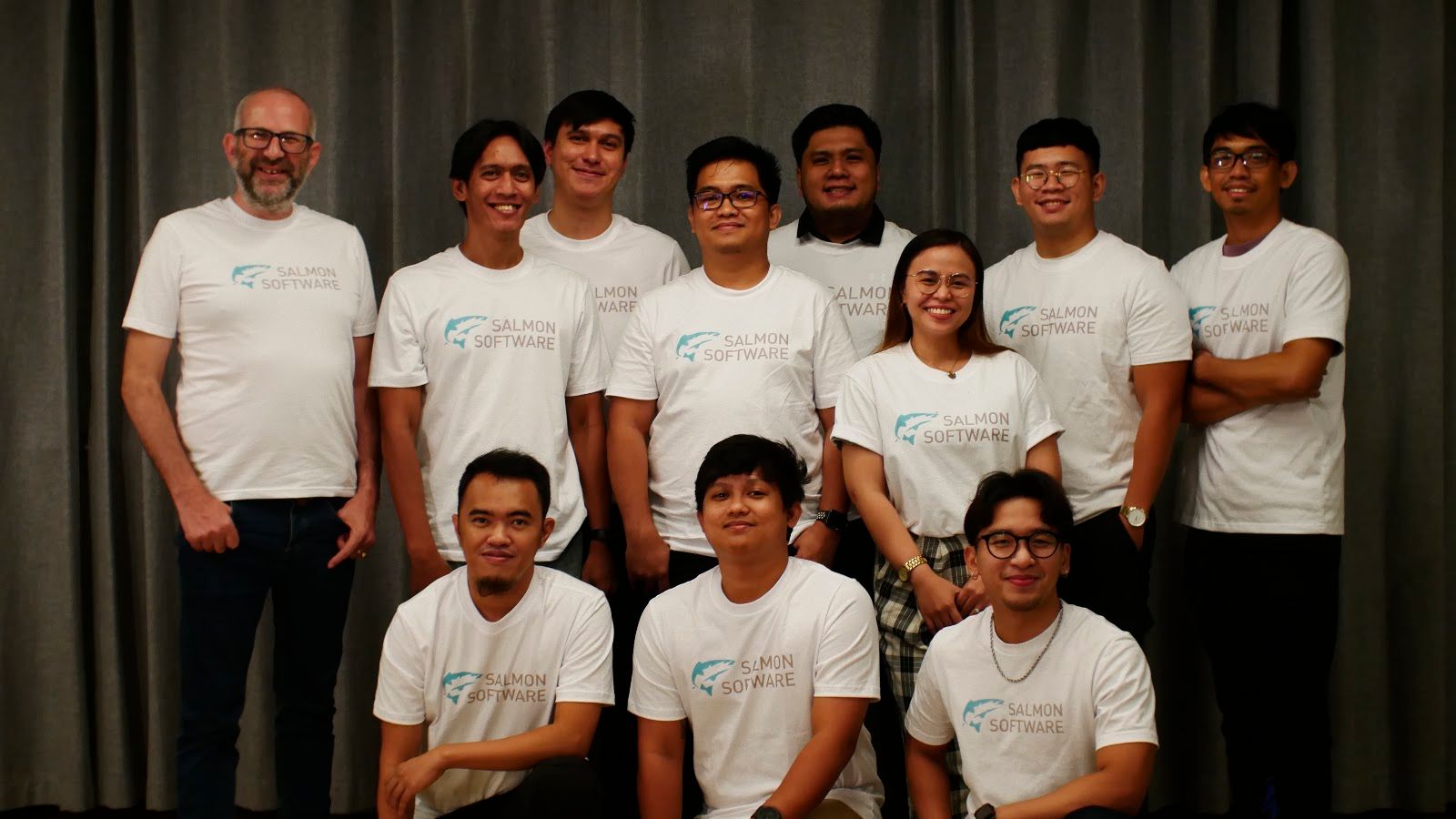
Marcus Kilgour, CTO at Salmon Software, wrote in his published review: "What I love about Cloud Employee is that you've taken all of that hard work off my shoulders." Salmon has since scaled to a team of engineers through Cloud Employee. You can read how Cloud Employee hires and supports engineers.
Nearshore vs Offshore Staff Augmentation
Both nearshore and offshore staff augmentation rely on dedicated remote engineers, but the working experience can differ significantly. For a deeper breakdown of overlap hours and rates, see our guide to nearshore vs offshore staff augmentation.
| Factor | Nearshore Staff Augmentation | Offshore Staff Augmentation |
|---|---|---|
| Time zone overlap | High, often 4 to 6 working hours with US teams | Limited, with little or no shared working time with US teams |
| Collaboration | Real-time communication | Mostly asynchronous |
| Feedback cycles | Faster, with same-day code reviews | Slower unless the team is async-ready |
| Monthly cost per developer | About $4,500 to $15,000 (LATAM, junior roles excluded; most senior placements $6,500 to $9,000) | About $3,500 to $5,500 (Philippines, junior roles excluded) |
| Best suited for | Teams that need high collaboration and fast iteration | Teams with documented, async-ready processes or that need continuous delivery (24/7) |
Cost is often part of the decision, but it should not be the only factor. Cloud Employee’s guide onchoosing nearshore or offshore software development explains how productivity, communication, costs, and time zone overlap often outweigh headline hourly rates.
Once the model is chosen, vendor selection is critical. This is explored inNearshore Software Development: How to Choose the Right Vendor, which outlines key criteria such as technical vetting, cultural fit, and long-term retention.
When Nearshore Staff Augmentation Makes Sense
Nearshore staff augmentation is becoming more common as companies adopt flexible, distributed workforce models. Local hiring is expensive and slow. The U.S. Bureau of Labor Statistics reports a median annual wage of $135,980 for software developers in May 2025 and projects the field to grow 10% from 2025 to 2035, against 3% for all occupations. Deloitte's 2024 Global Outsourcing Survey also lists skilled talent and agility alongside cost reduction as key drivers for outsourcing, which is why many teams are rethinking traditional recruitment.
Rather than treating nearshore as an alternative, growing teams increasingly use it as a standard part of their scaling plans. CompTIA expects tech occupations to grow about twice as fast as overall U.S. employment over the next decade, so local teams will keep competing for the same engineers. Nearshore offers stronger collaboration than offshore models while avoiding the cost and rigidity of expanding purely local teams.
Nearshore staff augmentation is especially effective when:
- You need to scale engineering capacity quickly
- Product development requires close collaboration and rapid iteration
- Business priorities may shift and team size needs to flex
- Long-term team continuity matters more than short-term delivery
If you are comparing providers, our ranked list of the best staff augmentation companies in Latin America shows how the main options differ.
Leadership Perspective
"Nearshore staff augmentation works best when companies treat engineers as a true extension of their core team, not as an external vendor. That mindset is what drives long-term performance, alignment, and retention."
- Seb Hall, Cloud Employee Founder & CEO
Nearshore Staff Augmentation Costs and Risks
Cost is where nearshore staff augmentation usually beats local hiring. As mentioned before, the median annual wage for software developers is $135,980, before benefits, payroll taxes, and recruiting costs. Cloud Employee's Latin America fees run $3,000 to $4,500 a month for junior engineers, $4,500 to $6,500 for mid-level and $6,500 to $15,000 for senior, based on 112 client placements from January 2023 to September 2026. That monthly fee covers salary, payroll, HR administration, benefits, and ongoing support. For rates by region, see nearshore vs offshore software costs in 2026.
Speed matters as much as price. Cloud Employee presents vetted candidates within 7 working days of your requirements call, so you can start interviewing in about a week instead of running a full local search. To weigh the trade-offs in full, read staff augmentation vs traditional hiring.
Nearshore staff augmentation has risks, and most come down to vetting and management. Time zone overlap varies by country. Neither Colombia nor Mexico changes its clocks, so overlap with US teams shifts by an hour when US daylight saving starts or ends. West Coast and European teams should confirm overlap before choosing a location.
Provider quality also varies, so look for technical assessments and live coding sessions rather than CV screening alone. Finally, agree in writing who owns the code, who employs the engineer, and what the notice terms are. A vetting checklist for LATAM providers covers the questions to ask before you sign.
What do nearshore engineers cost under each model?
Each model prices differently, and the basis matters more than the headline rate.
| Model | How it is priced | What to confirm before signing |
|---|---|---|
| Staff augmentation | Fixed monthly fee per engineer | What the fee includes, and whether any setup or placement fee applies |
| Dedicated team | Monthly team retainer or per-engineer fee | Whether QA and a delivery lead are included or billed separately |
| Project outsourcing | Fixed-price milestones, capped time and materials, or a project retainer | How change orders are priced and what early termination costs |
Source: common market pricing models, November 2026. Ask each vendor to itemise its own.
Cloud Employee's Latin America fee bands come from a cohort study of 112 client placements between January 2023 and September 2026: 39 in Brazil, 28 in Argentina, 23 in Mexico, 16 in Colombia and 6 in Uruguay. They are actual client bill rates from invoicing records, with each band set at the 10th to 90th percentile of its tier.
| Level | Monthly fee (USD) |
|---|---|
| Junior | 3,000 to 4,500 |
| Mid-level | 4,500 to 6,500 |
| Senior | 6,500 to 15,000 (most placements 6,500 to 9,000) |
Source: Cloud Employee cohort study of 112 Latin America placements, January 2023 to September 2026, invoicing records. The upper senior band applies to lead engineers and principal architects working at fractional-CTO level.
The monthly fee covers salary and employer payroll taxes, private healthcare and statutory benefits, an equipment budget, software licences and tooling, a dedicated Client Success Manager, HR administration and compliance, a £1,000 a year learning budget and free replacement if the engineer is not the right fit. There are no placement fees and no conversion penalties on the staff augmentation model.
What are the exit terms, and what happens if an engineer leaves?
Exit terms are where the models differ most, and where lock-in hides. For a fuller walk-through, see what to check in a staff augmentation contract.
| Term | Staff augmentation (Cloud Employee) | Dedicated team | Project outsourcing |
|---|---|---|---|
| Minimum term | None, one-month rolling | Varies, ask | Usually tied to the project |
| Notice to end | 30 days | Varies, ask for ramp-down terms | Tied to milestones, early exit often carries fees |
| Engineer resigns | 30 days' notice, you stop paying when they stop working | Ask | Vendor's problem within scope |
| Replacement | Free, 7 working days average and median (18 replacements, 2025) | Ask for a written timeline | Vendor's problem within scope |
Source: Cloud Employee contract terms and Talent Success replacement records for 2025, November 2026. Dedicated team and project outsourcing columns are market practice, not Cloud Employee claims.
Who owns the code and IP in a nearshore engagement?
Code and IP ownership are set by the contract, not by the model. Any of the three can be written so you own everything the engineers produce, and any can be written so you do not.
Get three things in writing from any provider, Cloud Employee included:
- The IP assignment clause itself, not a summary of it
- Who the engineer assigns IP to, and whether it passes directly to your company or through the vendor
- Whether the terms differ by country, if your engineers are spread across several
Treat a verbal assurance about IP as a prompt to see the clause. If a vendor cannot show you the written terms before you sign, put that on your list of warning signs.
What should you confirm before signing?
Most nearshore problems are visible in the contract before anyone writes code. Ask these six questions and get each answer in the contract or statement of work, not in an email thread:
| Question | What it tests |
|---|---|
| Who assigns work to the engineers day to day? | Management model |
| Who owns and prioritises the backlog? | Delivery accountability |
| What is the notice period, and is there a minimum term? | Lock-in risk |
| What exactly does the monthly fee include? | Pricing transparency |
| Who owns the code and the repos? | IP ownership |
| How fast is a replacement if an engineer leaves or is not the right fit? | Continuity |
Source: Cloud Employee vendor checklist, November 2026.
Watch for the warning signs listed in our guide on how to choose the right nearshore vendor: no written start date or shortlist timeline, no chance to interview engineers live before you commit, fees that appear only after signing, no named backup if an engineer leaves, and vague language on code ownership and repo access.
How do you choose the right model?
Start with your own team, not the vendor list. Three questions settle most decisions: do you have an engineering manager, is a sprint process running, and will the requirements still look the same by the time the work ships?
| Your situation | Model that fits |
|---|---|
| You have an engineering manager and a running backlog | Staff augmentation |
| You want a vendor-coordinated group and will write the management terms into the contract | Dedicated team |
| You have a fixed, well-scoped deliverable | Project outsourcing |
| Your requirements will keep changing | Staff augmentation or a dedicated team, not project outsourcing |
| You have no one to manage engineers day to day | Project outsourcing or a vendor-led team, not staff augmentation |
Source: Cloud Employee decision checklist, November 2026.
Be honest about the last row. If you have no engineering manager or sprint process, or you want a vendor to own a fixed scope, Cloud Employee's model is not the right fit.
Match the model to the management capacity you actually have. If you have an engineering lead and a running sprint, staff augmentation gives you engineers without handing over control. Cloud Employee has embedded more than 1,600 engineers in client teams this way since 2014.
For a useful quote, send the role, seniority, tech stack, start date and who will manage the engineer. Ask for a written monthly fee with its inclusions, notice period and replacement terms. Cloud Employee's fee bands and what they include are on Cloud Employee's pricing page.
Case Study: Mercato
Mercato needed to scale its development team without slowing product delivery. Local hiring would have added delays and stretched senior engineers.
Through staff augmentation, Mercato embedded dedicated developers directly into its existing team. With shared working hours and close collaboration, the nearshore engineers became long-term contributors rather than short-term resources.
Results:
- Faster delivery without compromising quality
- Reduced recruitment overhead
- A stable, integrated engineering team
👉 Read the full Mercato case study
Case Study: Travel Tech Client
A fast-scaling travel technology company faced increasing product demand and tight delivery timelines. Maintaining alignment between product and engineering was critical.
Using a staff augmentation model, the company expanded its engineering capacity while preserving daily collaboration. Engineers joined sprint ceremonies, worked closely with product leaders, and scaled alongside the business.
Results:
- Improved development velocity
- Strong cross-team alignment
- Long-term continuity without repeated hiring cycles
Many early-stage product teams follow a similar path. For more on how younger companies build with Latin American engineers, see our guide to scaling an early-stage SaaS team with LATAM engineers.
👉 Read the full travel tech case study
In Summary:
Nearshore staff augmentation gives growing companies a practical way to scale engineering teams without losing quality, control, culture, or momentum. By combining dedicated talent, time zone alignment, and operational support, it bridges the gap between local hiring and traditional outsourcing.
Related reading:
- What Is Nearshoring? Benefits and Challenges for Software Development Teams
- Explore more in the Staff Augmentation Hub
FAQs
What is nearshore staff augmentation?
Nearshore staff augmentation is a hiring model where companies add dedicated engineers from nearby regions and time zones. These engineers work as part of the internal team rather than as an outsourced vendor.
How is nearshore staff augmentation different from outsourcing?
Outsourcing transfers delivery responsibility to a third party. Nearshore staff augmentation keeps delivery in-house while extending capacity with dedicated engineers.
Is nearshore staff augmentation more expensive than offshore?
Nearshore rates are typically higher than offshore but lower than onshore. Cloud Employee's Latin America fees run $4,500 to $6,500 a month for mid-level engineers and $6,500 to $15,000 for senior engineers, against about $3,500 to $5,500 in the Philippines (junior roles excluded). Many teams choose nearshore because improved collaboration and speed often outweigh the cost difference.
What are the main nearshore staff augmentation models?
The three most common are single-engineer augmentation, a dedicated team, and a blended nearshore and offshore setup. Single engineers fill one skill gap, dedicated teams take on a whole product area, and blended teams pair nearshore leads with offshore execution to balance collaboration and cost. In every model you direct the work while the partner handles HR and payroll.
How fast can I add engineers through nearshore staff augmentation?
Cloud Employee presents vetted candidates within 7 working days of your requirements call. Local searches usually run longer, so nearshore staff augmentation can shorten your hiring timeline. Onboarding speed then depends on how well your tools and documentation are set up.
What are the risks of nearshore staff augmentation?
The main risks are uneven provider quality, limited time zone overlap in some locations, and unclear contract terms. You can reduce them by choosing a provider with technical vetting, confirming overlap hours before you commit, and agreeing who owns the code and employs the engineer. Our vetting checklist for LATAM providers is a good starting point.
Is nearshore staff augmentation the same as a managed service?
No. In staff augmentation you manage the engineers and own delivery, and the vendor handles employment. In a managed service or project outsourcing, the vendor manages the team and is accountable for a defined scope.
Who manages a Cloud Employee engineer day to day?
You do. Engineers report directly to you and work in your Slack, standups and sprint planning. Cloud Employee's Talent Success Manager runs onboarding, weekly scorecards and quarterly health checks, and a Client Success Manager coordinates annual increase reviews.
What notice do I get if an engineer resigns?
At Cloud Employee you get 30 days' notice, and you stop paying when the engineer stops working. A replacement averaged 7 working days across 18 replacements in 2025.
Are there setup, placement or conversion fees?
Not on Cloud Employee's staff augmentation model. There are no placement fees and no conversion penalties, and you start paying when the engineer starts.